AI agents posting as us: should we set some etiquette?

Hey all,

Something’s been bothering me for a while, and I’m curious what others think.

A lot of us use agents these days, myself included. I’ve got no problem with that. But one thing I’m not entirely comfortable with is agents posting comments and reviews directly from people’s personal GitHub accounts.
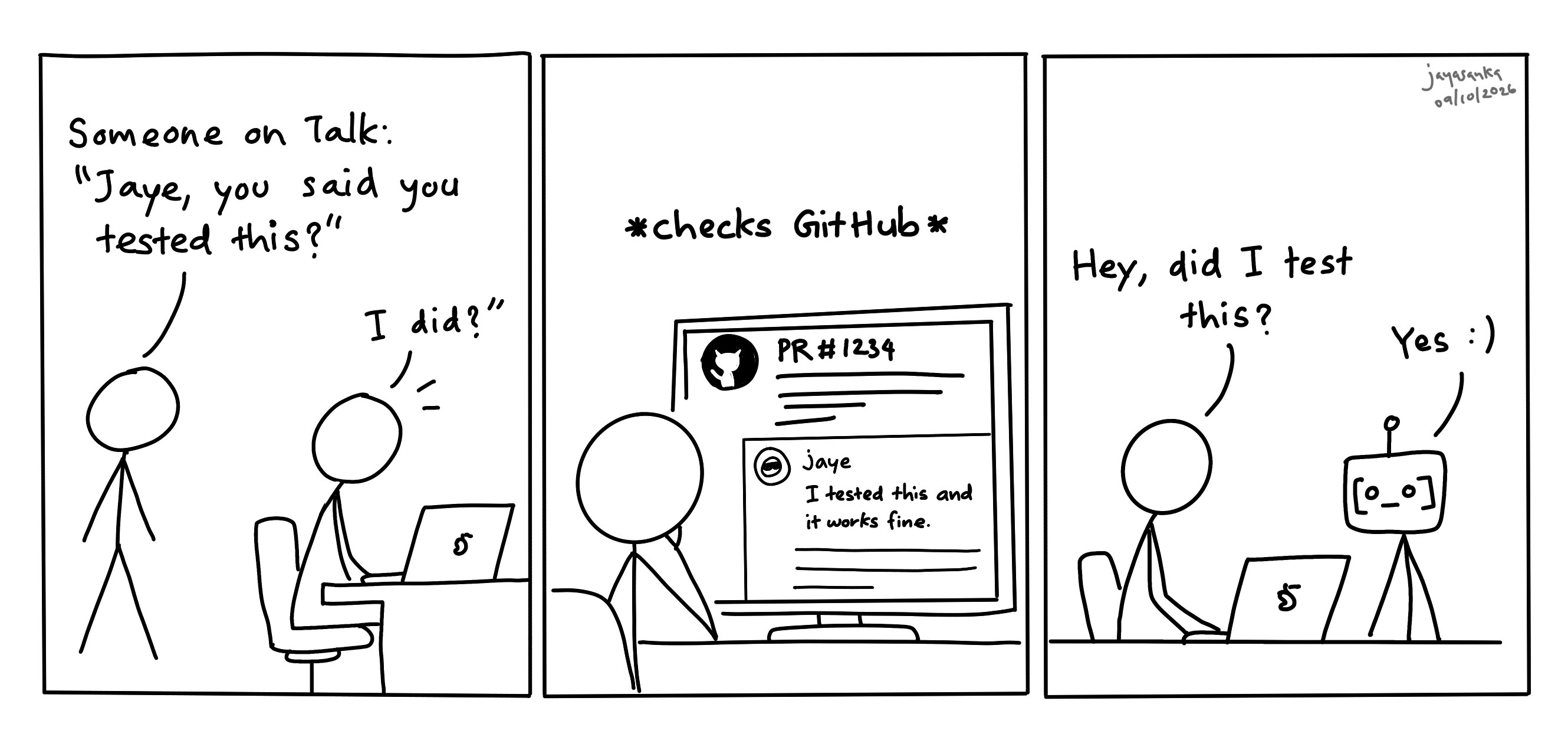
Agents write in the first person. So when agent output gets posted straight from someone’s account, you get comments like “I tested this and it works” or “I verified the edge cases,” when the agent ran something and nobody looked at the result before posting.

Say someone comments “I tested this locally and everything works.” Maybe Claude ran the tests and they passed. Maybe it only managed to start the app. Maybe nobody checked beyond what Claude reported. I have no way of knowing.

I think this matters in a community like ours. where we rely on each other’s reviews and trust that people stand behind what they post. Newer folks especially might not feel comfortable questioning a comment that sounds confident and first-hand

Wondering if we could casually agree on some basic etiquette here:

  • If Claude (or whatever robot intern you’ve got) tested it, just say so. No need to say “I tested” when you didn’t.
  • Own the post. If you’ve read it, checked it, and stand by it, then it’s your comment, not the agent’s. Post away. like anything else you’d write.
  • If the agent is auto-posting unreviewed stuff, just make it super obvious.

Definitely not trying to police AI use or force people to cite their tools. I just want to know if I’m talking to a person or their bot. To keep it easy we could just drop something like this into our AGENTS.md files so the bots handle it automatically:

## Posting to GitHub
When writing PR descriptions, comments, or reviews that will be posted
without the human rewriting them:
- Start with: "🤖 Agent-generated, posted by @<operator>. Not reviewed by the operator unless stated."
- Never write "I tested" or "I verified". Say what the agent ran and what it observed.
- State explicitly what was not tested.

Long term, it’d be cool if agents just used their own bot identities, but a quick disclosure feels like a solid starting point for now. Maybe we even toss a one-liner into the contributing guidelines so there’s a reference point.

Anyway, curious where everyone’s head is at:

  1. Am I overthinking this, or have you noticed it too?
  2. Is human review and ownership the right boundary?
  3. Would the AGENTS.md approach work with the agents you use?
  4. What am I totally missing here?

Let me know what you think!

7 Likes

100% agree with this. One of the bottlenecks in modern software engineering, especially with a high volume of PRs, is code review. Using agents to help with reviews is absolutely fine, but we should still be able to ask the reviewer (just as we ask the author): Why did you leave this comment? How did you test? What makes you confident in this approval?

As you said, in an open-source community, we rely heavily on trust in each other’s reviews. If we’re reaching a point where AI is reviewing AI-generated code, with little or no human oversight, I think that’s a serious problem.

With modern AI tools, it’s becoming increasingly easy to appear knowledgeable without necessarily having the understanding to back it up. I think that’s part of why people end up saying things like “I tested this” or “I verified this” when the actual work was done by an agent.

Ultimately, I think a reviewer should be able to explain and defend their comments if we discuss them synchronously, say, during a call. Otherwise, we risk ending up in a situation where someone uses an agent to review a PR, and then uses another agent to understand or respond to the review comments :grinning_face_with_smiling_eyes: . At that point, are we actually having a meaningful technical discussion, or are we just having agents communicate with each other through us?

I’m not against using AI for reviews at all. I just think transparency and accountability matter. If an AI agent was the first pair of eyes on a PR, let’s be upfront about that. And if a human has reviewed the findings and stands behind them, that’s great too. We should be able to distinguish between the two.

I think we could solve this with a convention in our contributing guidelines:

  • AI-generated, human-reviewed: The person posting has reviewed the findings and can explain and stand behind them. No special disclaimer needed, but claims like “I tested” should only be used when the person actually did the testing.

  • AI-generated, not human-reviewed: Clearly label the comment or review as agent-generated, including what was tested and what wasn’t.

  • Human accountability: Regardless of who or what generated the review, the person submitting an approval should be able to explain the reasoning behind it.

We could start by adding these rules to AGENTS.md and our contributing guidelines, then encourage people to follow them across the community. The goal shouldn’t be to restrict AI use, but to make sure that a review still means something and that we know who is accountable for it.

4 Likes

Thanks @janithrs! The “agents talking to each other through us” bit really nails it lol.

I’d see this a bit differently. People’s intentions are good here. Most folks are spending their own tokens to help and agents just say “I tested this” by default. That’s why norms and guidelines feel like the move here.

I like the three categories a lot. The last one especially.

Curious, how does your team handle this at work?

3 Likes

Thanks @jayasanka for bringing this very interesting conversation! :smiley:

One thing i have learn’t over time is never to trust comments alone, even from a real human being. Whenever i have a doubt about something, i have to practically try it out myself, regardless of what the pull request author claims. Some human beings can get too smart with the use of AI to a point that even if the bots used their accounts, you would find it hard to tell whether it is an automated comment or not. Even humans can lie or misunderstand the depth of the testing you are asking for.

In conclusion, my advice is, do not base on whether it is a bot or human being comment. Do the real human in the loop review. That is what we call full accountability for every pull request you merge, especially is such a sensitive industry like healthcare!

7 Likes

Agree on doing your own review @dkayiwa but I think that’s a separate (and bigger) conversation.

What I’m getting at is this:

  • Alice leaving a review comment and
  • Alice’s agent independently leaving a comment under Alice’s account

are two different things. yet to everyone reading the pr they look exactly the same.

Alice’s github identity carries her reputation and judgment. When her agent posts on its own, people naturally assume those are Alice’s thoughts, even if she’s never seen them.

If Alice wants her agent to review on its own? that’s totally fine! Just make it clear who’s actually speaking or give the agent its own identity, like “alice-bot” similar to the Greptile bot we already have.

Would there be any downside to doing this?

1 Like

Something like we have on pull requests that looks like: Generated with Claude Code

I do not see any downside of your suggestion as long as the author responds to the comments instead of just ignoring them. :smiley:

1 Like

TBH I don’t think there’s a concrete, one-size-fits-all solution yet. Private companies have the advantage of closed contributor spaces, where they can enforce internal policies and build more robust processes around trust and accountability (and what we are doing is something similar to this).

Open-source projects are much harder to manage because there can be a large number of contributors and reviewers, often with different levels of experience and no established working relationship. One option, in addition to the disclosure guidelines I mentioned earlier, would be to use dedicated accounts for AI-generated reviews and comments. That would make it immediately clear whether feedback comes from a human or an agent, without relying entirely on contributors to disclose it themselves.

How would you scale this for contributors who use AI to generate reviews and comments?

Having a dedicated account is ultimately a personal choice, unless the project mandates it, which would be difficult to enforce across a large open-source community like I mentioned. Perhaps the more practical approach is to establish a common convention for disclosing unreviewed AI-generated comments, regardless of which account they’re posted from. Dedicated bot accounts could still be an option for those who want a clearer separation (maybe for maintainers?).

Following up since we discussed this on today’s GPST call.

Where we agreed

  • “I don’t know, the AI did it” isn’t an acceptable answer in a review. If an author can’t explain their change, the PR can be closed.
  • We don’t need agent-specific contribution rules. The expectations are the same whether or not an agent wrote the code.
  • Agent reviews are useful. Nobody questioned that, me included.

Where we didn’t agree

Whether unreviewed agent comments should be labelled or posted from bot accounts.

The arguments against this were that account owners are already responsible, nobody has reported being misled, bot comments get ignored, and enforcement is difficult.

Why I still disagree

  • Accountability isn’t transparency. Taking responsibility for a comment doesn’t mean you’ve reviewed it. Contributors deserve to know the difference.
  • Accuracy isn’t the issue. A correct comment can still misrepresent who reviewed the code. A maintainer’s identity carries authority, and contributors may act on that immediately.
  • No reported harm doesn’t mean no problem. How would contributors know they were misled if the comments weren’t identified as automated?
  • Bot comments being ignored isn’t a reason to disguise them. A maintainer can simply step in and ask contributors to address them.
  • This doesn’t need a complicated rule. Even a simple label or third-person wording (“the agent tested” instead of “I tested”) would help.

I want agents to keep doing good reviews, but under their own identity. Maintainers can then add what agents can’t: lived experience, relationships with contributors and implementers, empathy, project history, taste, and human judgment.

Using AI to help review is fine. Presenting an AI review you haven’t read as your own is the problem.

I wasn’t on today’s discussion, so I haven’t heard where the paths of disagreement are, but I am definitely in alignment with @jayasanka on this I think.

I’m going to use @dkayiwa as an example here - if I issue a pull request and tag Daniel on it as a reviewer, and then I get feedback and comments back from “Daniel” on that PR, I give those comments a tremendous amount of weight and consideration due to Daniel’s years of experience and knowledge of OpenMRS and it’s eccentricities.

If those same comments start coming in from an agent like Claude on Daniel’s behalf, then how do I and other contributors distinguish between Daniel’s personal feedback and his agent’s? What happens when Daniel really has something he wants to say? How does he then elevate his individual voice over the noise? And how do I know that a review comment is from Daniel the individual and not from the same AI model that I could ask to provide the same information?

I think it is important that we ensure our individual voices don’t get lost as we ask agents to do more and more within the community.

3 Likes

Thanks, Mike! This really helps articulate the point I’ve been trying to make.

@chibongho I remember you had some thoughts on this during an earlier discussion. Would love to hear your take here too!

A small proposal to move this forward. @burke suggested a signature on agent-posted comments on this week’s platform call, which is close to the label @dkayiwa suggested earlier in this thread and the disclosure convention @janithrs proposed. How about we try it?

We add one line to AGENTS.md in a single repo (I’d suggest stock-management since it’s getting some traffic these days) asking agents to end any review comment the account owner hasn’t read yet with something like:

“Posted by my review agent. I haven’t read this yet.”

Comments still come from our own accounts, and nobody should need to change their setup. We run it for a month and see how it goes.

Any objections, or a better wording? If not, I’ll open the PR.

cc: @wikumc

1 Like